The craft chain of handmade cigars is far more complex than 'one minute to roll'. This article breaks down the key judgments at each step from leaf selection to aging.
The Complete Process of Making Handmade Cigars
In March 2019, I spent an entire morning in the rolling room of a medium-sized factory in Estelí, Nicaragua. The air smelled of the sweet tang of rehydrated tobacco leaves and cedar wood shavings, with fans pushing warm air from one row of workstations to the next. The master roller across from me was named Luis, then 47, who had been rolling for over twenty years — his calluses were as thick as patches. He pressed his thumb against a freshly formed bunch, shook his head, and unraveled it to start over — not because the wrapper was torn, but because he felt the middle section was "too firm." That cigar was eventually tossed into the waste bin.
That moment shattered my romantic notions: people talk about handmade cigars, saying "it takes less than a minute to roll one" and "the master's fingers can speak." In reality, that one minute of rolling is merely the most visible link in an entire chain. Whether the leaf selection is correct, whether the filler's air channel is unobstructed, whether the molding locks in the roundness and density, and whether post-rolling aging rebalances moisture and aroma — these determine whether you get a smooth burn or a cigar that goes out halfway or clogs from the first draw.
Below, following the common factory process for handmade long-filler cigars (Totalmente a Mano, Tripa Larga), I break down leaf selection, filling, wrapping, molding, and aging, and try to capture how the master craftsmen make their on-the-spot judgments.
I. Leaf Selection: Character Is Set from the Plant's Height
A handmade cigar consists of three layers from inside to outside:
| Layer | Common Name | Primary Role |
|---|---|---|
| Filler | Filler / Tripa | Main flavor body and combustion structure |
| Binder | Binder / Capote | Holds filler together, initial shaping |
| Wrapper | Wrapper / Capa | Appearance, mouthfeel, partial aroma and burn uniformity |
In public literature and growing-region practice, the position on the sun-grown plant roughly corresponds to different strengths: the bottom Volado (light leaf) burns easily with mild flavor; the middle Seco (dry leaf) contributes more aroma; the upper Ligero (light/high leaf) is strong and burns slowly. A very few top-tier blends use the even stronger Medio Tiempo from the very top, which typically requires more fermentation and longer waiting.
The wrapper is a different story. In many Cuban and Caribbean systems, high-quality wrapper comes from shade-grown (tapado) fields: fine mesh filters out part of the direct sunlight, producing larger, finer leaves with better oil content and elasticity. Factory-side public accounts often describe wrapper air-drying on the order of about 50 days, pile fermentation for several tens of days, then grading by color, size, and leaf integrity. Filler and binder leaves are strictly monitored for pile temperature during fermentation.
My assessment: leaf selection is not about picking nice-looking leaves, but about choosing leaves that should play a specific role in this size and this blend. For a thin ring gauge, cramming too much Ligero will ruin both combustion and draw resistance; a large-ring, full-flavored specification lacking mid-section aroma leaves will end up bitter and hollow.
The "Second Life" in the Factory
Tobacco leaves don't go straight to the rolling table upon arrival. Typical steps include:
1. Unpacking and reconditioning: Wrapper leaves fear sudden wetting. Gradual humidification in a ventilated room until the leaf is soft enough to bend without cracking.
2. Stemming and sorting: Wrapper leaves are often folded in half to remove the main vein; graders sort by color, size, oil content, and insect holes.
3. Blend sorting: The Master Blender requisitions leaves from the warehouse by brand and specification: origin batch, part proportions, aging years.
During a 2018 visit to a factory near Santiago, Dominican Republic, the QC manager handed me two wrapper leaves that both looked brownish-green and oily. One bounced back quickly and felt cool and smooth; the other was slightly astringent with brittle edges. If the latter were forced onto the rolling table, it would crack as soon as the spiral tightened. Color deceives the eyes; elasticity doesn't lie to the fingers.
Common issues are straightforward:
- Insect holes and damage: Small holes can be avoided by cutting around them; penetrating damage is rejected outright.
- Uneven moisture: A moist stem and dry tip will inevitably crack or bubble during rolling.
- Batch mixing: If the ratio of leaves aged 18 months to those just off the pile is off, burn rates will fight each other.
II. Filling: Airflow Matters More Than Stuffing Full
The core of long-filler handmade cigars is the Buncher folding whole filler leaves, aligning them, and rolling them into a bunch using the binder.
The operational logic typically goes:
1. Lay out the binder (a mild,pliable leaf, sometimes rejected wrappers or Volado types).
2. Stack several long-filler leaves according to the blend with Ligero mostly along the central axis.
3. Align and fold, ensuring a central draw channel rather than a tangled mess.
4. Roll from the foot, trim the head after forming, and place into the mold.
The cigar Luis tore apart had its problem in step two: the Ligero in the middle was stacked too thick. His standard: the firmness should feel like a just-ripe avocado.
Failure Patterns at the Filling Table
| Phenomenon | Common Cause | Smoking Experience |
|---|---|---|
| Plug | Twisted filler, too tight, residual main vein | Can't draw or suddenly blocks |
| Hollow/too loose | Insufficient fill, gaps between leaves | Hot, fast, thin flavor |
| Uneven burn | One side dense, one side sparse | One side ash, one side flame |
| Ammonia pungency | Insufficient aging or fermentation | Hits on opening the box |
Around the early 2000s, the Cuban export system was discussed for structural issues; from about 2005 onward, draw testing before wrapper application was emphasized, later trending toward checking every cigar. Today, many non-Cuban boutique factories also use airflow meters for spot checks. Machine readings are useful, but old-timers still lightly draw on the bunch themselves.
Personal view: consumers fixate on wrapper gloss when buying, but what truly drives the experience gap is, nine times out of ten, the filler airflow. Apprentices often stumble here, practicing folding without twisting for months. Filling is muscle memory, not a skill you learn by watching one video.
III. Molding: The Wooden Mold Is Not a Decorative Step
The bunch goes into a wooden mold, with multiple layers of planks pressing against it, given time to set the roundness and density. Different factories range from about 45 minutes to several hours.
Molding accomplishes three things:
1. Geometry: Stabilizes ring gauge and roundness so the wrapper fits snugly later.
2. Density: Evens out the air betweenloose leaves, reducing local voids.
3. Handover: Provides the Roller with a standardized semi-finished part.
After unmolding, skilled workers give it another squeeze. Molding cannot fix fundamental filler errors.
IV. Wrapping: Appearance Is the Result, Uniformity Is the Goal
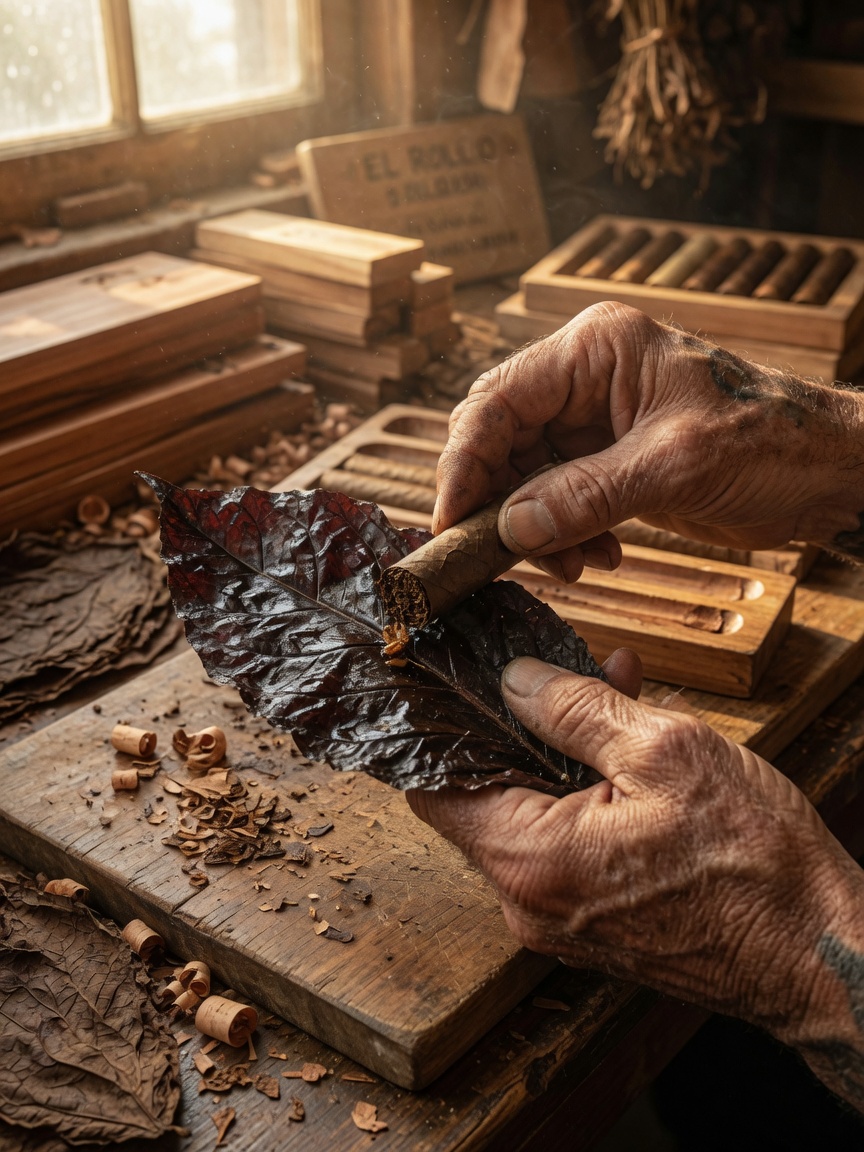
The unmolded bunch is handed to the Roller / Torcedor. The basic steps are:
1. Select a wrapper leaf matching color and size, with the shiny,smooth-finished side facing out.
2. Trim the edge, removing the overly thick base or uneven edges.
3. Starting from the foot, spiral-wrap with steady tension.
4. Make the Cap: cut a small round or flag-shaped piece, adhere with vegetable gum.
5. Visual inspection.
Good wrapper wraps as if the leaf wants to stick to itself; bad wrapper needs glue. The cap determines your first experience when cutting the cigar. Luis's habit: after cutting, he would roll the head with his fingertip to feel whether the seam bit. If the head is loose, no matter how beautiful the cigar, it is still half-done.
V. Aging: Time Can Harmonize, but Cannot Resurrect
Post-rolling steps include:
1. Quality inspection: weighing, measuring ring gauge and length, hand-feel, sampling by test-draw.
2. Conditioning and pest control: fumigation, freezing targeting tobacco beetle (Lasioderma serricorne).
3. Post-rolling aging: approximately 16-18°C, 65%-70% relative humidity, from about three weeks to months or even 9-18 months.
What aging cannot fix:
- Structural plugs and severe hollow cores
- Mold and rancidity
- Inherent bitterness or imbalance in the blend
- Loosely structured cigars with thin leaves may simply become milder and drier
VI. The Master's Judgment: Teachable Rulers, Earned Intuition
Hand: leaf can fold without cracking; bunch uniform density; finished cigar rebounds on light squeeze.
Eye: wrapper color uniform, natural oil; burn line even; ash compact.
Smell and Draw: no pungent ammonia; draw has resistance but doesn't strain the lungs.
Time Experience: knowing which batch needs more rest, which field's Ligero burns the tongue.
I trust the finger + instrument + sample draw trio more than mythologizing either side.
VII. Compressing the Entire Process into a Sense of Time
Field to harvest: several months. Curing: tens of days. Fermentation: tens of days. Warehouse aging: months to years. Rolling day: minutes to hours. Post-rolling aging: weeks to months.
When you pay a high price for handmade cigars, you buy land, time, loss rate, and human judgment.
VIII. In Closing
Choose the right leaf, fill for airflow, mold for shape, wrap for fit, and age enough. Everyone can recite the skeleton; the difference lies in thetrade-offs at each step. Handmade does not automatically mean better; it only means there is a chance to achieve levels machine short-filler cannot reach. Cigars are tobacco products. If you want to understand why this cigar draws smoothly and that one clogs, remember that filler airflow and leaf aging matter more than anyorigin story.
(End)
Machine Short-Filler
Fast, low cost, high consistency, but limited flavor complexity and burn uniformity
Handmade Long-Filler
Higher failure cost, time-consuming, relies on human judgment, but higher ceiling for airflow and blend